" height="41.855079948054374px" id="jtsq6Ll11" transform="translate(3.586 4.004)" width="141.65808959934216px"/></g></svg>)
How to talk design to anyone in the C-Suite
Change perspective to get noticed
At a recent design event in London I attended, one of the designers posed a question to the panel: “As design leaders, how do you communicate your design vision to executive teams — CEOs, CFOs, CTOs — effectively without creating perceived overhead?”
It’s a question every designer, particularly those early in their career, needs to answer. And the answer might surprise you.

In a single, simple sentence, when you talk to people who arguably don't care about design, you don’t talk about the design per se.
Sounds counterintuitive, but bear with me.
Non-design people are not interested in pixels and colours. For them, design is often just a pretty picture — drawing and animating are fun. They struggle to see its inherent value, often dismissing it as a waste of time.

How juniors talk about design
I like to distinguish designers’ seniority by the questions they ask about design:
Juniors ask, ‘What do we design?’
Mid-levels ask, ‘How do we design that?’
Seniors ask, ‘Why do we even do that?’
So when juniors talk about design, they talk about colours, typography, and icons. They can spend hours elaborating about letter spacing or the beautiful button they’ve created.
They can spend hours arguing about Inter vs Helvetica or any other nitty-gritty detail.
When they present the design, they are fixated on how the design looks. And when challenged, they usually respond, ‘Sure, we can still change this.’ A senior designer, yet, asks, ‘Why are we doing this at all?’, framing design within broader business objectives.
So, how do you talk to the executive team about design?
Cash, baby…
What do Exco people care about?
Money.
What? Do they not care about business?
Of course! To make more money.
Do they not care about users?
Of course they do! More customers = more money.
Ah, that sounds awful!
Well, yes. But that’s the point.
The secret behind running a business
They run the business. Their job is to bring more money to the business. This ensures the company is more profitable, generates more revenue, gains market share, attracts more customers, and achieves greater reach.
Any senior leader, from the Head of Department level up, deals with the annual budget. Within that budget, they need to find a way to get objectives delivered — objectives set up by their Directors.
Directors, in turn, receive objectives from their superiors, usually the Exco.
And what are these objectives?
Increased profitability
Increased customers acquisition
Increased market share
Reduced costs
Exco design talk cheat sheet
To succeed in high-level design conversations, you need to change your perspective. Stop thinking about how the design looks; start focusing on how it works.
Design isn’t just aesthetics, it’s not colour, icons and typography. It’s about functionality (Hi, Steve!)*
Only then will you be able to say something like this: ‘That button redesign increased customer conversion by 5%, leading to twice the revenue last month’.
When you can link design decisions to tangible business outcomes, then they will listen to you.
There are three elements you can connect your design decisions to the business:
Customer
ROI
Value
Customer
Your design decisions directly impact user experience. Successful design can increase conversion, improve onboarding, reduce churn, and lead to positive feedback. It can also reduce Customer Support calls, all contributing to increased customer satisfaction. That is exactly what Exco wants to hear.
ROI
Every pound (or dollar, euro, zloty, etc.) spent on design should return 1.x or more in scale. We don’t design for awards or a pat on the back; we design to make money. So, if you spend two weeks on a new button, then another two weeks and £KK on user testing, the final expected outcome must be increased conversion. This should lead to revenue that multiplies the initial expense. Simple.
Value
And this is a keyword: value.
Exco members can see the value provided by design if they can clearly see its significant and tangible impact on the business situation. This is a direct correlation. Successful design delivers business value (conversion), customer value (retention and satisfaction), and representative value (market share and recognition). Ultimately, it generates revenue over time. When that’s proven, design earns its importance, a seat at the table, and becomes part of the strategy.
Beyond these, strong design also mitigates risk. By understanding user needs and testing solutions early, design prevents costly rework. It also stops the launch of features nobody wants.
Voice from others
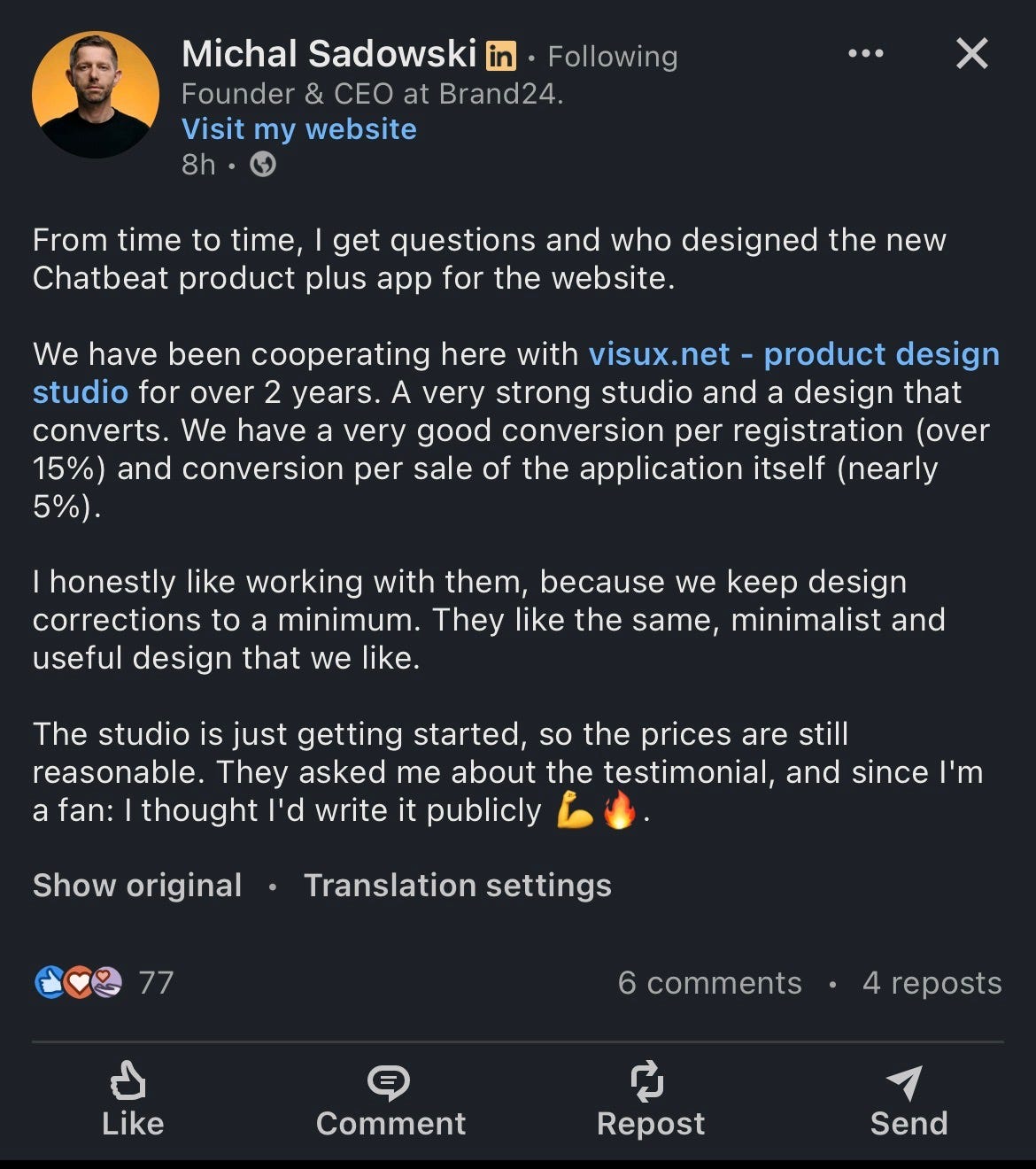
While writing this article, I opened the LinkedIn app. The first post I saw was from Michal Sadowski, Founder & CEO of Brand24. In it, he praised a product design studio his company collaborates with, for delivering design that converts.
There you go…
Your next step
So next time when someone asks you about your design decision, don’t articulate the ‘What’ or the ‘How’. Focus on the ‘Why’, and tell the story of how your design will help the company to achieve its objectives.
When presenting a design, if someone challenges your decision, your answer shouldn’t be ‘Sure, we can still change it.’ Instead, respond like this: ‘Based on current user feedback, we know the existing design causes XYZ issues. This new design aims to fix it. We will run usability testing to gather real user opinions, and based on their feedback, we will implement a solution. Then we will run A/B testing with another version to choose the winning solution.’
Then you’ll quickly become a valuable conversation partner, elevating both your work and your influence.
—
*(As Steve Jobs famously said, ‘Design is not just what it looks like and feels like. Design is how it works.’)