Are we there yet?
A reality check on user-centric design, speed pressure, and the AI loops replacing actual human users.
The User-Centric Design presentation, delivered by the Hippo agency and the FCA as part of Leeds Digital Festival, was not boring. It wasn't exciting either. It wasn't a waste of time, though.
The room was larger than I could expect.
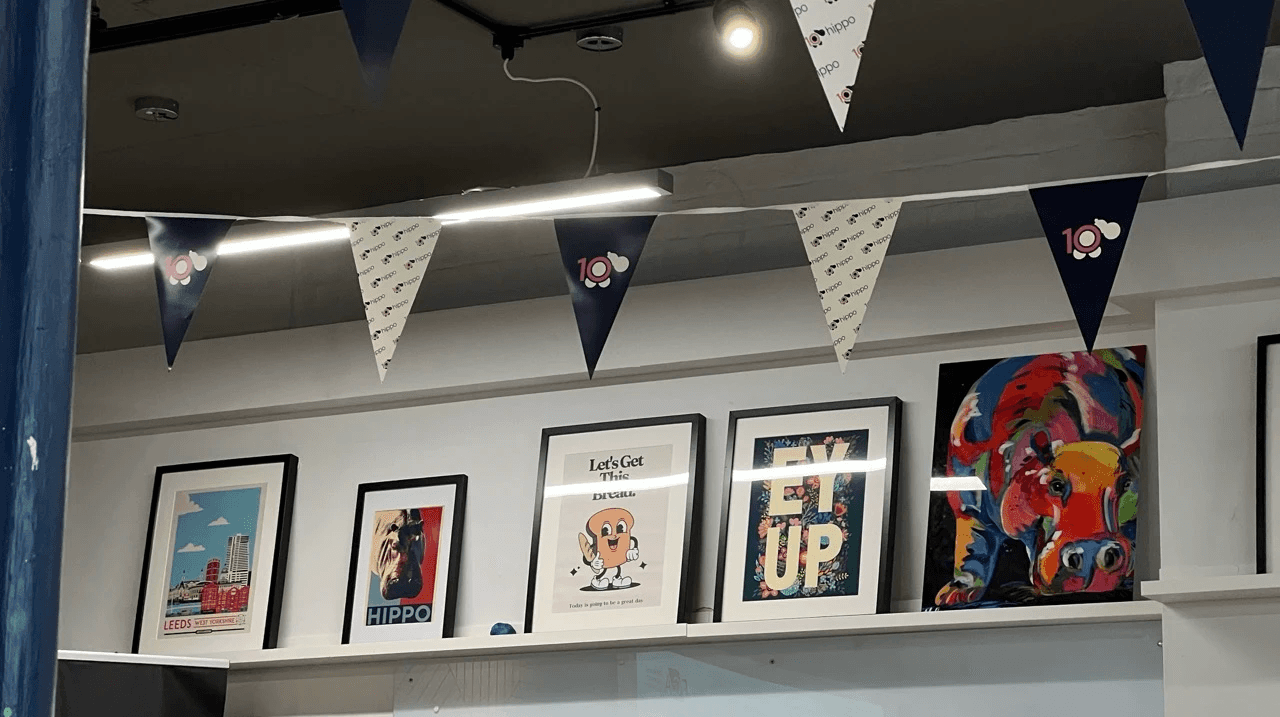
The large, barn-like sliding door at the back of the coffee shop separated it from a workshop or meeting room utilised daily by a consultation agency from Leeds called Hippo. A row of branded pictures and posters sat on a high shelf along the wall. Paper bunting hung from the ceiling, all carrying the Hippo logo, giving the place away.
People were gathering and seating themselves around tables. Four of them. The last table remained empty—not sure whether deliberately or just by chance.
The tables were large enough to fit eight, but at my table, three chairs remained empty. It was the same at the others. That was the organisers' direction. They wanted to group people in fours, but the total number would not add up, so they allowed for a random setup. Perhaps that flexibility allowed for a freer flow of thoughts later.
People got comfortable.
Despite my usual hesitation toward such events, I sat comfortably and spread myself wide, using an empty chair to rest my arm. The man opposite me was busy connecting his phone to the Wi-Fi. Reception wasn’t great.
Two women exchanged greetings, names, and roles. They were different in every way possible. The only thing they had in common was a care for the user. The last man joined us just before the host called for attention. A few people ran late; they had struggled to find the place hidden behind the barn door.
Five people of different ages, backgrounds, roles, and statuses all shared the purpose, drive, and hopes that had brought them to the event.
The User-Centric Design event
The User-Centric Design presentation, delivered by the Hippo agency and the FCA as part of Leeds Digital Festival, was not boring. It wasn't exciting either. It wasn't a waste of time, though.
I learnt something important during the session that not only surprised me, but also confirmed my perspective on the role of the user and the business perspective in shaping user needs.
As my role has recently evolved, I have been given much more ownership and responsibility for shaping customer experience. When you look at it from the outside, it makes perfect sense for CX to sit within the remit of the Head of Design at the bank.
Therefore, I'm arming myself with any extra knowledge, tools, or books I can find to share the CX fire around. Because, it may surprise you, not everyone—even high-stakes people—cares about customers as much as they say they do.
I always thought that everybody else was doing better than us.
At the bank, we went through multiple pivots, changes, strategies, and I guess the destination, the goal, was still somewhere to be found. Observing great brands growing one after another, rising on the wave of product-led strategies, caring about users, maturing design systems, and building strong brands, I lived under the conviction that everybody was doing it apart from me.
How wrong I was.
During the session, one of the two hosts shared a new tool allowing us to measure UCD adoption in our organisations. It was a type of questionnaire with 20-odd questions, rated 1 to 5.
All participants filled that in, and then we discussed the results. The questions surrounded two major themes:
How well can you assess UCD adoption in your organisation?
How do you rate UCD adoption in your organisation?
To my surprise, the results were rather… meh, if not poor. On a scale of 1 to 5, the average score was 3.
We discussed the results. People took the floor.
Due to obvious reasons, I cannot name the people I’m mentioning below, nor their organisations. It should be enough to say that the participants came from various UK organisations of various sizes, from small to large enterprises. That group included people from banks (which is always most interesting to me, given my fintech background).
Story 1
Imagine a scenario in which, as a designer, you are working towards creating a great experience for your product. As usual, the best way to validate your concept is to test it with users. What are your stakeholders saying then? Are they giving you a budget for research and user testing? Are they allowing you to spend a week talking to people who use your product?
No.
They respond: "As a designer, you are also the user, so you know whether it works or not."
Ba-dum, tss.
If only I could make this up. But that was a story shared by one of the participants. A slight murmur and plenty of nodding heads confirmed it wasn’t an isolated example.
Other people raised their hands to express their concerns and share their stories.
Story 2
Imagine a scenario where you are asked to create a concept for a new MVP.
The requirements are provided by BAs.
But we operate in the modern world, so they used Claude AI to gather, write, and deliver requirements. With recent changes, an optimisation programme, and a new way of working, you are expected to move fast.
So you frame the requirements into a complex prompt for Claude Design to quickly wireframe and prototype the concept.
The outcome is a more-or-less usable prototype that more-or-less meets the requirements, based more-or-less on your design system, which has also been connected to Claude (I cannot verify how well the design system was prepared for AI execution).
You take this prototype to stakeholders, asking to run user testing and validate the concept. Instead, you are asked to run an AI assessment. After all, you need to move fast.
So you put your Claude design into Claude to test it and ask whether Claude was right and correctly understood the requirements gathered by Claude.
You could literally be talking to yourself in the mirror and get the same result.
But it has been validated by AI, so it's accepted and pushed forward.
AI said so.
And you can only hope developers validate the code instead of vibe-coding or allowing Claude to run the whole show.
If I said I was stunned, that would be an understatement. Not by the fact that AI is used across the project—I already knew that. But by the fact it was a process onboarded by a large, mature organisation that should know better. But I guess time pressure and a shortened road-to-release led us to a point where we deliberately neglect the role of the end user in the process.
There are more of these stories. The majority of them are as shocking as these two.
Well, shocking? Not really.
We know the world we are living in, and we see the direction in which we are heading. We have also been in the business long enough to know that designers have been treated for years by ExCo as artists drawing pretty pictures. We are experienced enough to know that research budgets are a luxury. We know that a design-centric approach, user needs, and the double diamond are brilliant concepts often kept in lockers for a better day—a day when we have the time, money, and possibility to use them.
A day that never comes.
What is missing
One of the hosts of the workshop asked what is missing in our current workload and organisational setup to run UCD processes.
The common answer was: time.
Everything has to be fast.
Designers are asked to accelerate to the maximum, avoiding becoming blockers for developers. User testing, user-centric design, and the voice of the customer become a luxury.
Depressing? A little. Concerning? Yes, very much.
But I don't want to leave you with such a negative statement. I want to finish on a positive note.
The good side of the UCD event was that I realised I made a mistake when assessing our UCD maturity and execution.
I rated it a 2 in terms of assessing maturity and a 3 in terms of actual adoption.
Pretty low, I know, but that was the feeling I had at the time of the exercise. I didn’t know what I didn’t know, or maybe my idea of where we are vs. where we should be was dragging me down.
After reviewing my answers in the tool, analysing it deeper, and listening to all the stories shared, I realised it's actually better than I thought.
Actually…
Recent changes within the company brought in people who care about users—people who also listen and want to do what is right. I spent years elbowing and fighting for the user, building a culture of research and testing. I built the User Testing Club, which is now called upon for various testing purposes.
Thanks to the smart people I've had a chance to work with, we are putting processes in place, finding a research budget, and talking to customers.
I cannot say we have it all sorted, or that we know exactly what we are doing and where we are going. We are still trying to figure things out. Maybe it's not at the level I would hope for; maybe it's not as frequent or as wide-reaching as I would wish.
But when I look at the people at the event, and I compare their stories to where we are, I’m not feeling down anymore. I even feel a subtle warmth inside.
Don’t get me wrong, it’s not all pinky-blue, all singing and dancing; we have our challenges and time pressure. We are in process, searching for the right answers. But at least we have buy-in and a green light to move forward.
Your turn
So what can you do in your organisation? How can you change perspective and onboard UCD? There is no one golden key, one recipe, one way. But there are principles, guides, and laws that can support your case.
One of the key factors to increase awareness about UCD is Consumer Duty. If you work for a regulated organisation, that gives the FCA a reason to look at the experiences and messages you create. If your bank deals with EU customers, the European Accessibility Act will be another driving force to implement more rigorous checks.
Side note: even if your organisation doesn’t deal with EU customers, it’s good to meet standards that are raised. It’s what A-players do.
Finally, more and more organisations are opening their eyes and noticing the risks behind relying so heavily on AI, leading to an increased adoption of human-controlled processes (a term I coined for the needs of this article).
So keep lobbying and pushing for UCD in your organisation. Listen to what customers say and translate that into the language of business benefits. When money talks, stakeholders usually listen.
Are we there yet?
Not yet. But we are getting there.
(Note: The tool we used during the workshop belongs to the Hippo agency and I cannot share it without their consent.)