" height="41.855079948054374px" id="jtsq6Ll11" transform="translate(3.586 4.004)" width="141.65808959934216px"/></g></svg>)
How I structure meetings in my design team
A practical guide to mastering remote design meetings I tried and tested over 12 months.
I built my design team from scratch during my first year at Tandem in 2022. During the initial months, our focus was on learning to work together. At the beginning of 2023, I gathered everyone to kick off the design year with an intensive schedule of meetings.
Over the next months, I learnt what worked and what didn’t and adjusted it accordingly. This is my approach to the design meetings pattern we utilise at Tandem.
Far away, yet close
In my previous role, at Barclays Bank, my whole team worked in one office of the Barclays Technology Park in Knutsford. We sat next to each other and spent lunches together, bragging about new iPhones we bought, fighting over Premier League games of our favourite teams, and drinking beer after work. Yes, that was pre-COVID.
At the time, we didn’t have design meetings scheduled or reviews within a design team. According to our process, we should have “peer review” every week, but in reality, we were usually so deep in work that these were simply skipped.
However, because we sat next to each other, we swapped peer reviews into simply leaning towards the colleague, nudging him and asking, “Hey, you have 5? I need a second pair of eyes on this experience”.
These 5-minute have-a-look sessions sometimes changed into full team 30-minute discussions on the best approach to the experience we were creating. And that worked.
At Tandem, we have a slightly different setup — we all work remotely, and almost every designer lives in a different town. So leaning towards and nudging to have a look at the design is rather difficult.
Yes, we have Slack and other modern tools for remote work, yet being alone in the home office, far away from colleagues, doesn’t make it easier to collaborate.
Hence, it was important for me to organise regular design meetings to stay in touch, learn from each other and keep the team spirit going.
Therefore, in January 2023, I announced the plan and sent a bunch of calendar meetings blocking slots for 6 months in advance. My reason was to create a pattern of regular meetings so designers could expect them and plan their work accordingly.
The initial setup
When creating a plan, I followed advice from Martyn Reding, a Design Director at Expedia Group, previously Head of Design at Zoopla, and Virgin Atlantic.
In his online course Design Leaders Studio, Martyn suggested setting up regular weekly design review meetings, which all designers should attend and take an active part in providing feedback to colleagues’ designs. I liked this idea as a way to show what everybody is working on, and what they struggle with, and give all equal chances to grow in providing and receiving feedback.
On top of that, I added two regular calls: one on Monday to kick off the week, and one on Friday to close the week.
So here is the excerpt from my notes, describing these calls:
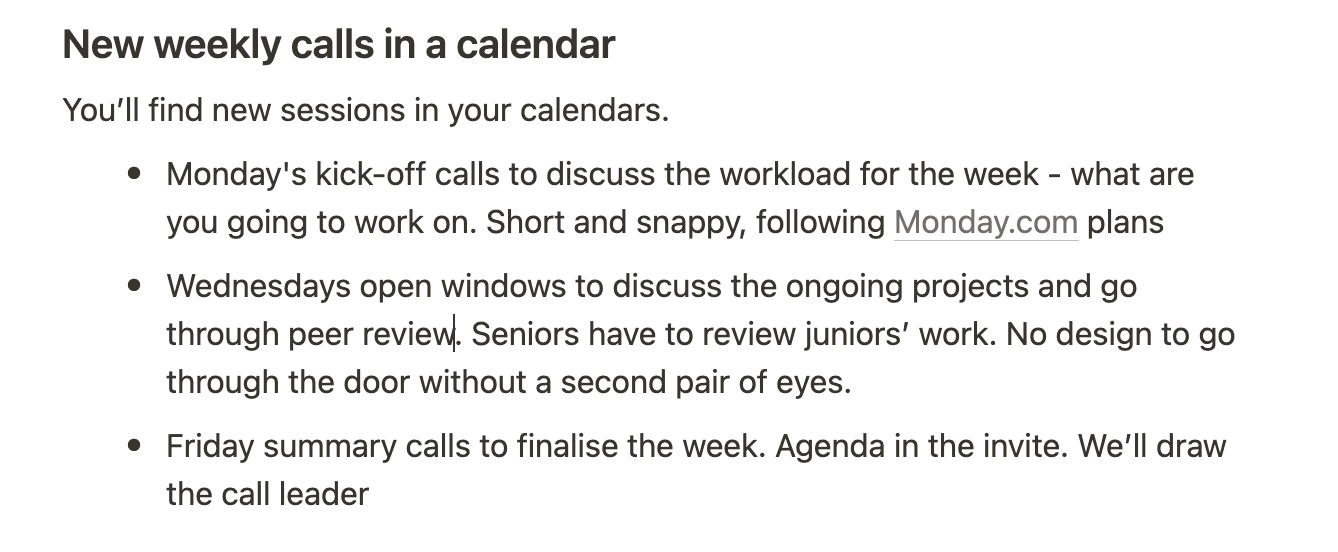
Screenshot from my notes
Monday’s kick-off calls to discuss the workload for the week — what are you going to work on. Short and snappy, following Monday plans (screenshot shows Monday, as it was a tool we use dat the time. Since then have moved to Jira)
Wednesdays open windows to discuss the ongoing projects and go through peer review. Seniors have to review juniors’ work. No design to go through the door without a second pair of eyes.
Friday summary calls to finalise the week. Agenda in the invite. We’ll draw the call leader
So as you can see, on the screen, only 3 calls for the week should not create a burden…
Well, about that…
Details
Kick-off Calls
At the time, we used Monday to track our work, and I scheduled 15-minute calls on Mondays at 9:00 am to go through tickets. Quickly, these changed into another standup, often problem-solving, 30-minute-long calls. Something that was not supposed to be.
Design Review Calls
The review calls I scheduled on Wednesdays at 12:00 (yes, at noon) and for 2 hours (yes, I know). It was driven by the fact that 6 designers were going through their work, and it always took some time. Yet, lunches were often late or eaten while on the call. Neither was ideal.
I must clarify, though, that often we only used 1 hour of the review sessions, as not all designers had something to review, and with the work pipeline, I didn’t want to keep it blocked for 2 hours, so I made it voluntary to attend.
Friday Summary Calls
The idea was that each week another designer is running the call. That way I wanted to motivate them to step out of their comfort zone, speak out more frequently, and learn to drive meetings — a super useful skill if you want to grow a designer. That was planned for 3 or 4 pm on Friday, so that would be the last call of the week, allowing all to summarise the work and relax.
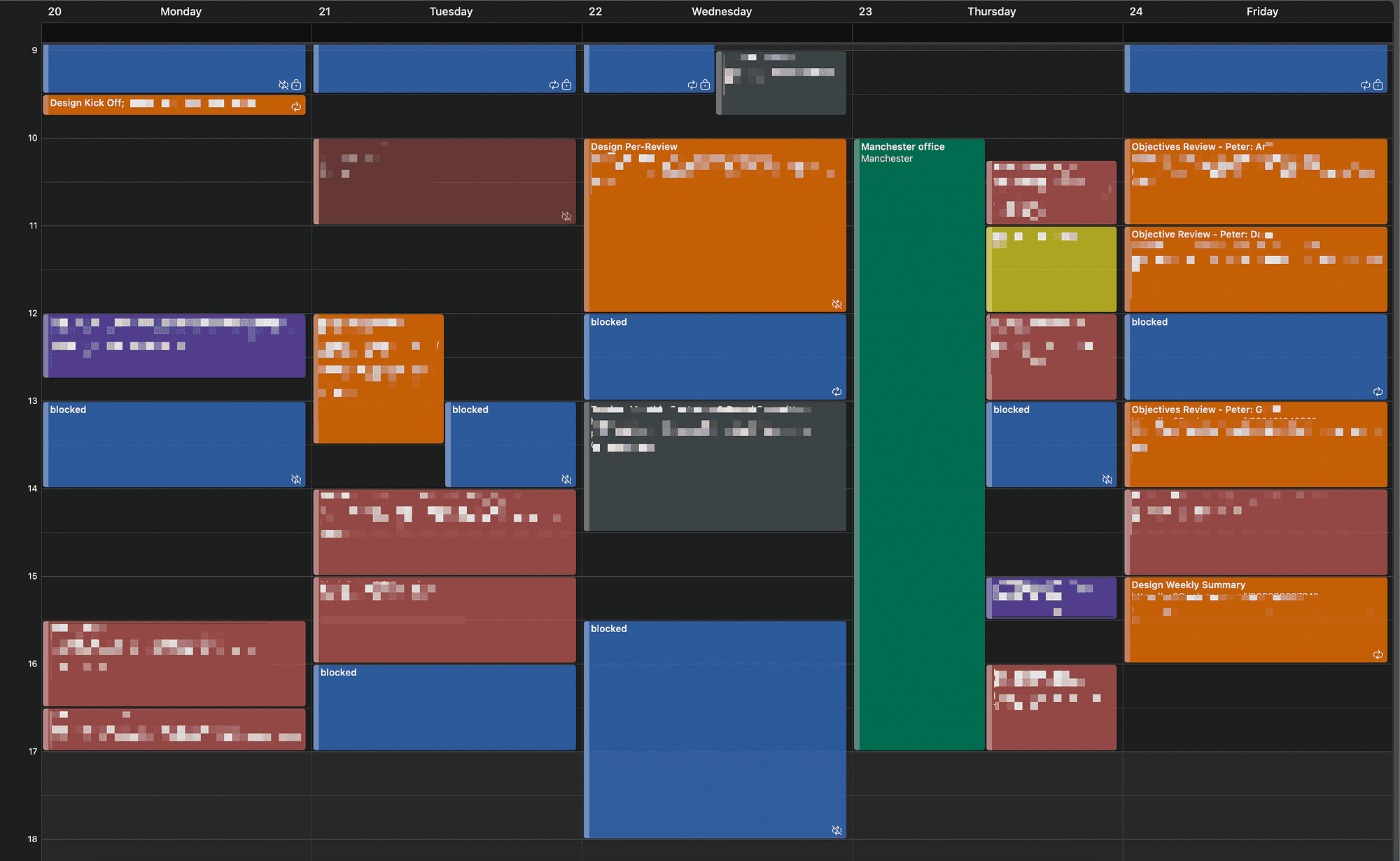
Screenshot of my calendar week view back in March. Orange blocks are design meetings.
What worked and what did not
Over the year, we changed only two elements of the Monday kick-off call:
We moved from Monday to Jira
We made it 15 minutes sharp.
It follows a simple schedule:
No problem solving, no other agendas — check Jira tickets and off we go.
One significant challenge we encountered was the growing number of meetings. With all the project meetings designers had to attend, a 2-hour-long block for the design review on Wednesday lunchtime became problematic.
During one of our Design Team Get-Togethers (see more information below), we collectively agreed to remove that. Instead, we switched to review on-demand, and later to the async review, and the latter worked very nicely until now.
Friday’s call remained almost unchanged, with a quite structured agenda:
We also made it quite informal and easygoing allowing all to switch off after the whole week.
One thing I need to work on though, is to make others speak out more often. It may be the case of personalities or the Zoom call, but still, some are keeping mics off and do not speak until specifically asked.
What we have added or changed
During the year I have added a few solutions aiming to simplify the process and allow to stay us on top of the agenda.
Design Leadership calls
Every two weeks I meet with my two senior designers to discuss operational topics, team dynamics, processes, and changes, and to decide how to solve issues. Once every 2 months we run a Retro to see what worked, what didn’t etc. Thanks to that we were able to identify certain bottlenecks in the design process, simplify operations, and ditch Wednesday review calls.
1:1’s
One-on-one meetings are the ones I need to work on the most still to create as much value as possible out of them. Initially, I scheduled them once a month for an hour with each designer, After a few months I heard feedback that there were too many meetings. So I changed them to 30 minutes and limited them to objective tracking only. That also didn’t work skipping important conversations about current workload, issues and plans.
So this year I’m planning a new setup of 1:1’s. I still hold them once a month, but make them 45 minutes, so we have time to discuss ongoing stuff as well as touch on the objectives’ progress. Since we moved into annual objectives, the monthly checking is less important.
Async review
That was the biggest and most welcome change of the year. We ditched the long weekly design review calls for async.
What is the async review, and how do we run it?
Asynchronous review, if you didn’t hear that term, is the method to meet out of sync. In our case, the designer seeking a review is recording a video with screen-share, presenting their design, walking through it, and sending it over. Then I can watch it and review it on my own time and come back with my feedback.
We have begun testing a tool called Claap for that, and we loved it! (This is not a sponsored article, by all means, but I would always love some swag if you want to send it through, Pierre 😉)
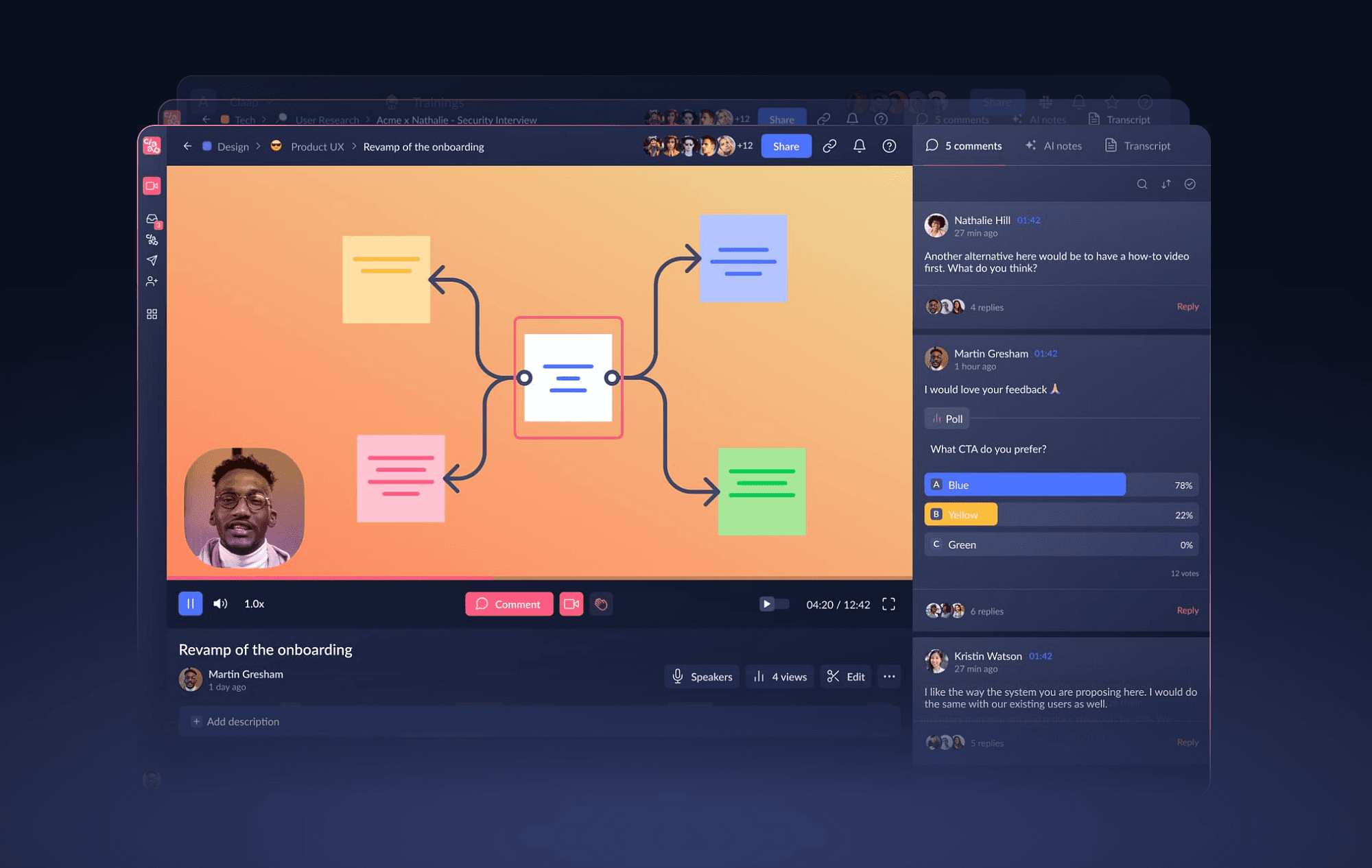
Screenshot from the Claap website
We could use a Cleanshot (my favourite app for screenshots) or any other screen recorder and send the video over Slack.
The advantage of Claap is the commenting feature within a video, though. You can pause a video at any time, mark the area on the screen and comment on it. All comments are grouped in the sidebar, and every viewer can add their comments, including recording a video response. Pretty neat!
Sounds like Figma comments?
Yes, it does. Because it’s pretty much the same idea. However advantage of the video is that the designer can explain their thinking process and the decisions they made, taking the viewer on the journey step by step. It’s an opposition to sending a prototype link to stakeholders, asking them to click through screens without any context. Very often, comments then are based on the “I like/I don’t like” rather than meaningful conversation.
A Claap video allows for explaining not only What and How was designed, but also (and more importantly) — Why.
Status update
We implemented another change during the year, addressing designers without squads (researchers, graphic designers) who do not attend daily standups for progress updates.
We have set up a Slack channel for daily updates, where at the end of the day, these designers can summarise their day in a few bullet points explaining what they have done. That also allows me to come back on my own time and review their work.
In my opinion, Status updates could easily replace most daily standups, providing the Product Owner or Project Manager with enough details about the work that was done and keeping up to date with the workload.
Office work
Even though we work remotely, we tend to meet face-to-face as well. My team is scattered, yet we manage to work together from the office at least once every fortnight. We meet either in our London, Blackpool or Manchester office. Not all at the same time, unfortunately, as some live too far to travel every 2 weeks, long distances.
Anyhow, that’s a great opportunity to spend some time together, brainstorm on design challenges and grab a beer after work. Like in the old days.
On a side note, I was a huge advocate of remote working, and I still love working from home. However, I learnt that office time together with a team is as important, and I’d be happy to come once a week to the office or more often if we had a dedicated creative space for the team, instead of hot-desking.
Design Team Get Together
The final type of meetings we run at the Design team is quarterly get-togethers. Roughly every three or four months, I gather all my designers for 2 days to work and have fun together. We either travel to London, Manchester or the Blackpool office. Each time we have a different agenda, but generally, we work together on strategy and way of working, we discuss and solve design team priorities, or run a design hackathon.
After that, we have time for fun together, drinks and team bonding exercises, which don’t suck. Every time we delegate one person to organise dinner and activities. They usually come back with a few options to choose from and we vote using the survey tools.
Any future changes
At this moment, I’m not planning to add any other types of meetings or amend these existing ones. But as always, things can change. Next month, we plan to conduct a retro session with my senior designers. and will discuss if all the above works or if we need any changes.
In my opinion, since we operate remotely, there needs to be a balance between crucial meetings and work. However, the Designer’s sanity needs to stay in sync with other designers. Yes, there is Slack and quick Huddle to jump on an ad-hoc basis, or multiple channels to discuss all sides of the design, and they will remain. What I’ve noticed, though, my team remained close to each other and lived in great harmony due to the balance between meetings and solo work time.
Key Takeaways
So this is my method of running meetings with designers on my team. I experiment, change and alternate if needed. I listen to what people say and try to come up with better solutions.
Balancing crucial meetings and solo work time is essential.
Regular retrospectives with your team can help fine-tune your meeting approach.
The Design Thinking approach involves experimentation, adaptation, and continuous improvement.
—
This article was originally published on Medium on 24 January 2024